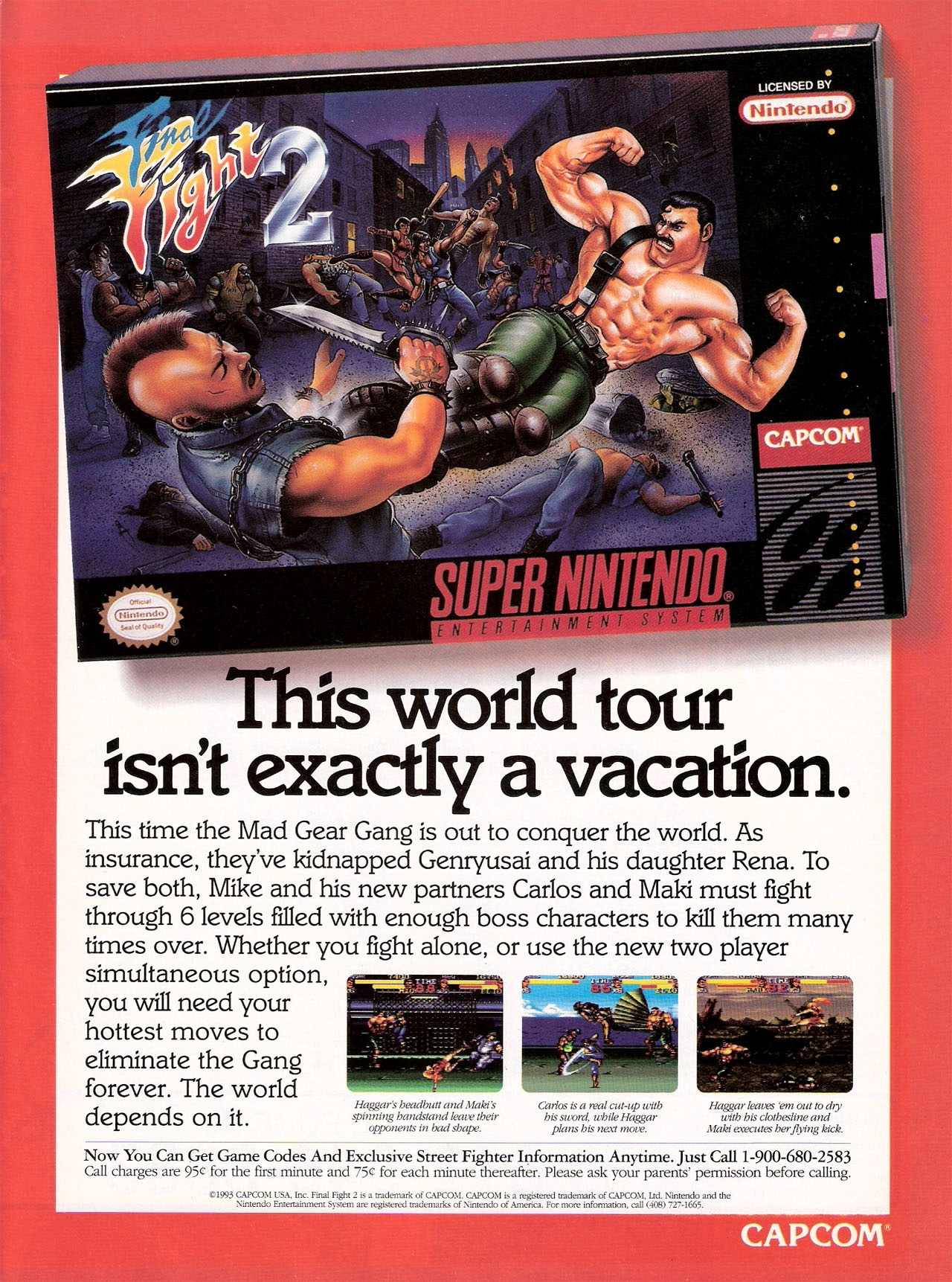
After a rather poor home adaptation of the arcades of the original Final Fight, in 1993 the sequel to Capcom's beat’em up arrived exclusively to the Super Nintendo. It kept only one of the main characters of the original edition, Mike Haggar, and this time the game allowed two players to play at the same time. The mayor of Metro City would be in this installment accompanied by Carlos and Maki in an adventure that would lead them to break bones literally all over the world with the goal of rescuing Geryusal, Guy's (one of the protagonists of the first installment) teacher and his daughter from the clutches of the always fearsome Mad Gear gang.
As occurred previously in the adaptations of the original Final Fight, the Eastern and Western versions had different variants, some more logical than others. In those days, although an internal Capcom team was in charge of the localization and regionalization of the titles, many of the modifications were requested directly by Nintendo's American subsidiary, whose guidelines were quite strict and aimed to avoid any conflict, mainly, with groups of parents who frowned upon certain content with which their children played.
Below we will see some of the most striking differences between the editions of both hemispheres. The reasons for these modifications may be due, as mentioned above, to Nintendo's own request or a preventive decision by the developers, in any case, the result is, at least, curious.
Weapons
From the very beginning we can notice Capcom's magic touch in relation to the character of Won Won, the first boss of the game that makes his appearance on the coasts of Hong Kong, a city quite visited by the world of video games and cinema back in the early 90s.
In the Eastern version of the title, the Chinese antagonist has, in his left hand (top photo), a sharp butcher's knife that he does not hesitate to use to attack the player, however, in the version released in the rest of the world, the knife is nowhere to be found.
Gender changes
A fairly common practice at the time, especially by Capcom, was to replace the sprites sprites of female enemies and transform them into male antagonists depending on the region where the game was released. Final Fight 2 was no exception, as you can see in the images on the right, in Asia the title had female enemies while in the West it did not (lower image). Although the male enemies had the same movements as the female ones, the aesthetic difference was clearly visible.
It should be noted that in the adaptation of the Super Nintendo port of the first Final, this difference (among many others), was also present, with the particularity that in Western territories, Poison was replaced with another generic enemy, which resulted in a lot of criticism from fans even back then. Perhaps by his own personality or by this decision, Poison became one of the favorite Capcom characters, which would make him appear in several other games, even as a playable character within the Final Fight franchise where the gang member is a member of Final Fight Revenge roster.
The mystery of the sign
Although some of the changes could be defined as controversial or simply unnecessary, perhaps the most absurd is the one in the France stage where the sign that announces the direction in which, I believe, tries to be the famous French airport "Charles de Gaulle" is located.
In the Japanese version of the game, the Parisian airport was renamed "Chailee de Gaulle" in what could well be a spelling error of some kind, however in the Western edition the sign no longer shows the name of the airport anywhere.
The change, or omission, may be due to the fact that it was simply much easier to erase the airport name in terms of programming and design than correcting the characters so that the name looks good.